Will a 3.0 GPA Get You Into College?
Confused by your transcript? Discover how colleges evaluate a 3.0 GPA, weighted vs unweighted scores, and credit hours to maximize your acceptance chances.

Will a 3.0 GPA Get You Into College?
The short answer is yes—a 3.0 average will absolutely get you into college. However, the real secret is knowing how modern admissions boards review your GPA.
Imagine opening your university application portal after months of waiting. Then you realize your academic future hinges on one baseline number.
For thousands of high school seniors moving through their senior year, this anxiety regarding college admissions is incredibly real. You have worked hard and balanced your schedule. You have maintained consistent performance throughout. Still, you may wonder if your academic profile stands out today.
It also means shaping your transcript to increase acceptance letters from many colleges and universities.
Table of Contents
- The Hidden Anxiety of the B-Average Applicant
- The Transcript Audit: How Your Score is Built
- Navigating Weighted and Unweighted GPAs
- Mapping the Higher Education Landscape
- How to Flip the Odds in Your Favor
- Frequently Asked Questions
- Final Thoughts
The Hidden Anxiety of the B-Average Applicant
Maintaining a solid average is a strong achievement. But as college application season nears, it is easy to feel overwhelmed.
You may hear stories of perfect scores and elite school rejections. Many students feel stuck in a cycle of comparison. They worry that a few freshman year mistakes or a low math grade closed college doors.
This admin stress can slow you down when you need to build a confident, forward-thinking college plan. Admissions officers recognize that a student is more than a static data point. To feel less stressed during the admissions process, you need to understand the exact math committees use.
They use this math to measure your academic potential.
The Transcript Audit: How Your Score is Built
The absolute first step in taking control of your admissions journey is auditing your true standing. Before worrying about school offers, you need to understand the mechanics behind the numbers. Let's look at this step by step.
To calculate your average, schools assign a numerical value to each grade you earn. They sum up these points and divide by the total number of courses or the total number of credits you have attempted. Because some classes have more credit hours than others, one grade can affect your GPA more. Examples include a daily science lab and a weekly seminar.
Understanding this foundational math helps you predict exactly how your final semesters will impact your transcript. This practice serves students well all the way through to applications for graduate school.
Navigating Weighted and Unweighted GPAs
Once you understand basic math, you must know the key difference between weighted and unweighted GPAs. Different schools use different grading scales.
An unweighted GPA judges every class out of a standard 4.0 scale. This means an "A" in a freshman intro course looks the same on paper as an "A" in a tough senior physics lab.
A weighted GPA, however, reflects course difficulty by awarding extra point values for advanced tracks. Admissions teams prefer students who choose challenging classes. Examples include AP or IB programs, AP classes, and honors classes. Earning a "B" in one of these demanding courses can often yield a higher point value than an "A" in a standard class.
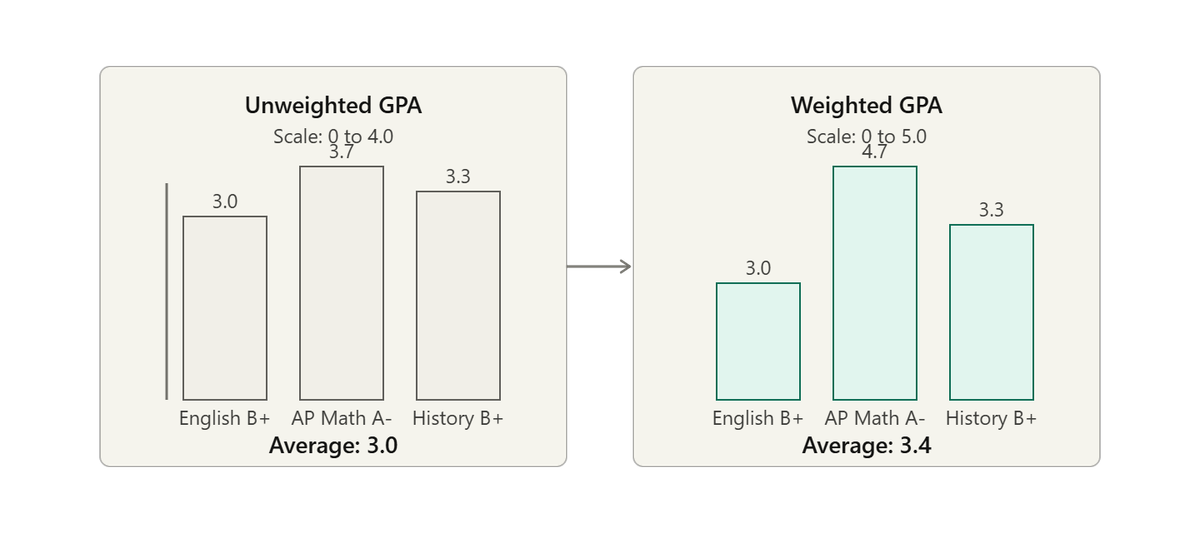
When universities review your application, they perform a deep dive into this balance. Using a reliable GPA calculator helps you review weighted and unweighted GPAs in real time.
It helps you judge your competitiveness before your application reaches a university.
Mapping the Higher Education Landscape
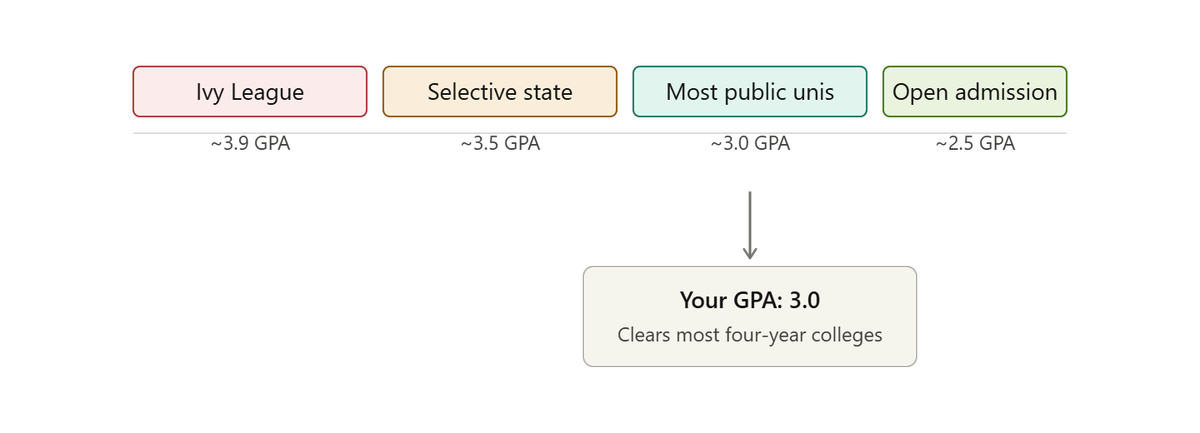
Your cumulative GPA holds different values depending on the specific tier of institution you are targeting. Aligning your expectations with institutional realities ensures a smooth application season.
When you aim for top-tier schools, you need near-perfect results.
This includes meeting Ivy League standards.
It also includes getting into selective private colleges. These schools have **extremely** low acceptance rates.
In these pool settings, achieving a 3.0 is a tough uphill battle. It often takes an exceptional portfolio or a strong life story. This can help you get past the first academic screen.
Fortunately, the vast majority of four-year institutions offer a completely different reality. A B-average comfortably clears the minimum admissions threshold at dozens of exceptional public universities across the country. Always check the specific GPA requirements listed on each individual college website.
Furthermore, many institutions use rolling admissions, meaning they review applications as they arrive, not after a fixed deadline. Applying early can help students with a 3.0.
It may raise their chances of acceptance before spots fill up. When researching colleges that accept a 2.5 GPA, an applicant with a 3.0 stands out.
They often seem well prepared and may qualify for automatic general admission.
How to Flip the Odds in Your Favor
If your cumulative GPA stays the same as deadlines near, focus on improving your story in the Common App. You can turn a solid transcript into a clear, must-accept file. Focus on these core pillars of a holistic review:
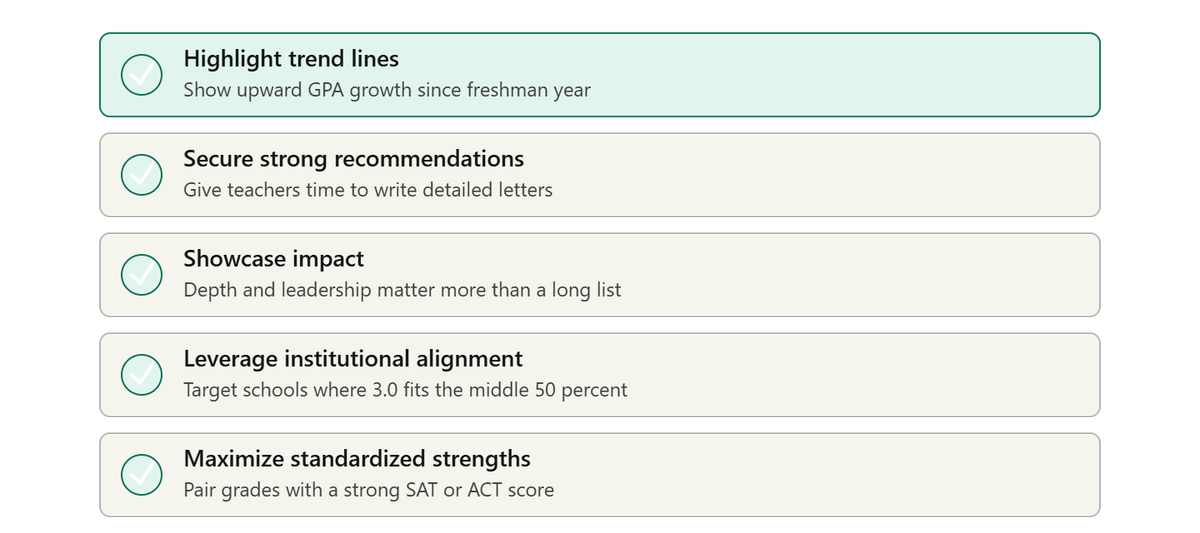
- Highlight Trend Lines over Totals: Use your personal essay to contextually explain any early academic adjustments. If your recent semester GPA is much higher than your freshman year GPA, highlight this change. It shows clear growth, momentum, and maturity.
- Secure Strong Recommendations: Give your teachers plenty of time to write detailed letters of recommendation. Admissions teams value external validation of your character and work ethic.
- Showcase Impact: Highlight your commitment to extracurricular activities. Depth of involvement and leadership roles often matter more than a long list of minor participations.
- Leverage Institutional Alignment: Focus on colleges where your score is within or above the middle 50 percent range. This can make you a strong candidate for institutional merit aid.
- Maximize Standardized Strengths: Many schools are test-optional. If your district uses standardized tests, combine strong grades with a high SAT or ACT score. This offers clear proof of your core academic skills.
Frequently Asked Questions
Can I still get into a great four-year university with a 3.0?
Absolutely. Hundreds of well-known public universities and private liberal arts colleges consider a 3.0 a strong minimum for admission.
Why do colleges value course rigor more than a perfect unweighted score?
Admissions teams prefer students who take challenging classes, not basic courses that only protect a high score. A weighted evaluation proves you are ready for college-level reading and analyzing.
Does a B-average qualify for institutional scholarships?
Yes. Many local public and private colleges offer tier-based merit scholarships starting at a 3.0 GPA. This is common when your application shows strong community service or leadership.
Final Thoughts
A 3.0 is not a limitation; it is a versatile launchpad. By learning how admissions teams review credit hours, course rigor, and your transcript story, you can apply with confidence.
Higher education doors are wide open for dedicated B-average students. Focus on showing a complete, honest, and well-organized view of your skills. Use your digital tools to check your metrics.
Your academic journey is just beginning, and the right campus is waiting to help you write the next chapter. Stay organized, plan your studies and application timeline carefully, and explore the diverse range.
Found this useful?
Try our free tools — calculate your GPA, check college GPA requirements, or generate an attendance sheet in seconds.