Free Rubric Tool Generator for Teachers(2026 Guide)
Build professional grading rubrics in minutes with a free rubric tool generator for teachers. Save time, boost consistency, and grade smarter.
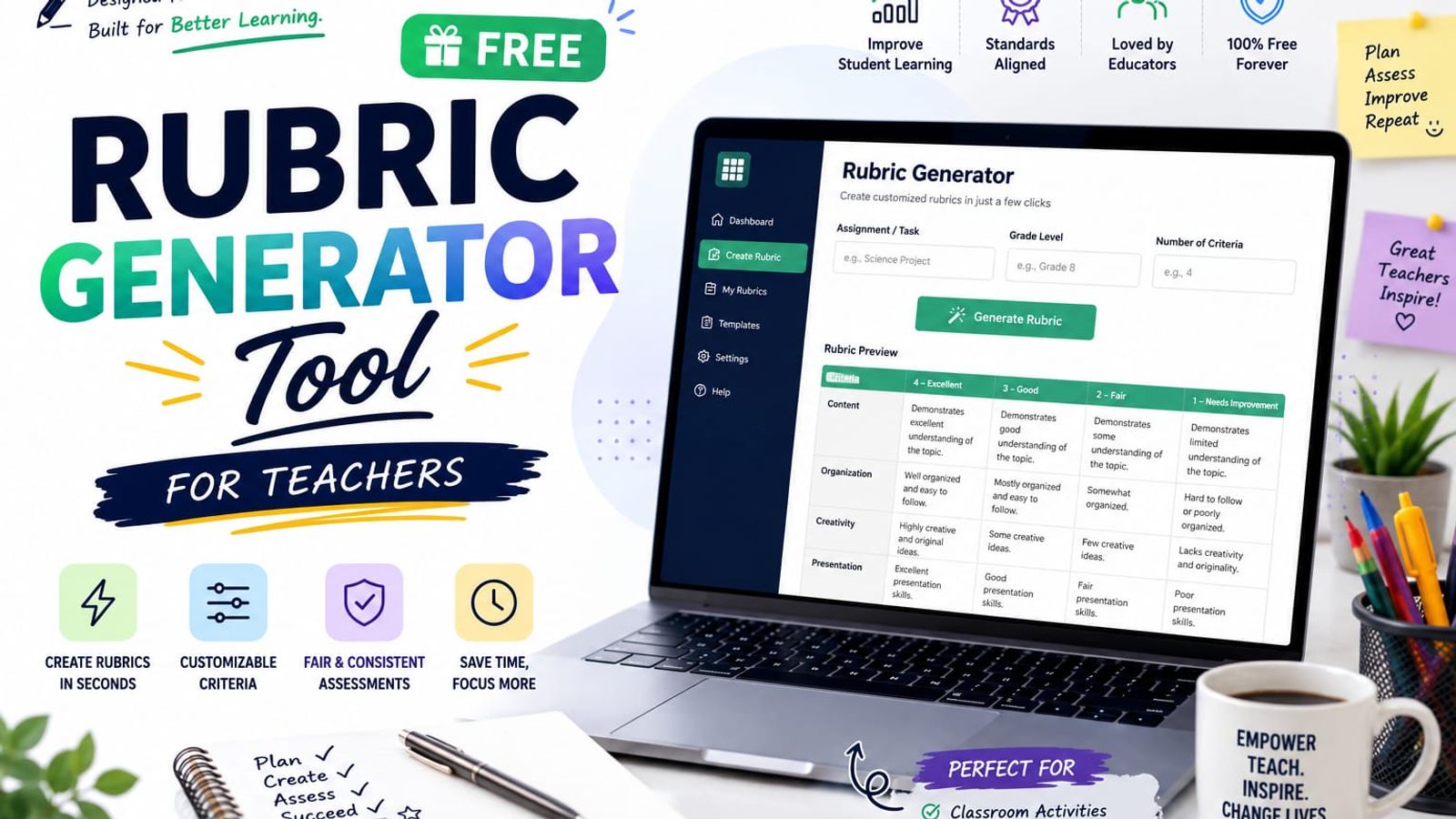
Free Rubric Tool Generator for Teachers: Grade Smarter, Not Harder
Grading papers on a Sunday night is nobody's idea of fun. If you've ever stared down a stack of essays with no clear way to score them fairly, you already know why a good rubric matters.
The good news? You don't need to build one from scratch anymore. A free rubric tool generator for teachers can turn a 45-minute task into a 5-minute one — and the results usually look more professional than anything hand-typed in Word.
In this guide, we'll walk through what these tools actually do, which features matter most, and how to pick one that fits your classroom. Whether you teach kindergarten or AP Literature, there's a rubric generator out there that will save your evenings.
What Is a Rubric Generator, Exactly?
A rubric generator is an online tool that helps teachers build scoring guides quickly. Instead of designing a grid by hand, you fill in a few details — assignment type, grading criteria, point values — and the tool builds a ready-to-use rubric for you.
Most free rubric makers for teachers include:
- Pre-built templates for essays, projects, presentations, and group work
- Editable criteria and performance levels (like "Excellent," "Proficient," "Needs Improvement")
- Export options for PDF, Google Docs, or printable formats
- Point-based or standards-based scoring options
Think of it as a template engine for grading. You bring the subject matter. The tool brings the structure.
Why Teachers Are Switching to Online Rubric Makers
Let's be honest — teachers didn't wake up one day and decide rubrics were fun. They switched because manual grading systems were eating up planning time that should've gone toward actual teaching.
Here's what's driving the shift toward a free rubric creator for teachers:
1. It Saves Real Time
Building a rubric from scratch, formatting it, and printing copies can eat up half a prep period. A generator cuts that down dramatically. Many teachers report going from 30+ minutes to under 10.
2. It Improves Grading Consistency
When grading criteria are written out clearly, it's harder for personal bias or fatigue to sneak into scoring. Students also get more consistent feedback across different assignments and different graders (helpful for team-taught courses).
3. It Makes Expectations Clear for Students
A well-built rubric answers the question every student silently asks: "What do I actually need to do to get an A?" When criteria are spelled out in plain language, fewer students argue over grades — and fewer parents email asking for clarification.
4. It Supports Standards-Based Grading
Many free rubric tools now let you align criteria directly with Common Core, state standards, or IB/AP frameworks. That's a big deal for teachers required to document standards alignment for administrators.
Key Features to Look for in a Free Rubric Tool Generator
Not all rubric generators are created equal. Some are genuinely built for classroom use. Others are stripped-down demos designed to upsell a paid plan. Here's what actually matters.
Customizable Templates
Look for a tool that offers templates across multiple formats:
- Analytic rubrics (detailed criteria, scored separately)
- Holistic rubrics (one overall score based on general quality)
- Single-point rubrics (one column describing proficiency, with room for notes)
If a generator only offers one rigid format, you'll outgrow it fast.
Easy Editing and Reusability
You should be able to duplicate a rubric, tweak the wording, and reuse it for next semester's class in a couple of clicks. If editing feels clunky, it defeats the purpose.
Export and Sharing Options
A free printable rubric maker should let you:
- Download as PDF
- Export to Google Docs or Sheets
- Share a link directly with students (great for digital classrooms)
No Hidden Paywalls
Some tools advertise "free" but lock templates, downloads, or editing behind a premium tier. Read the fine print before committing your class set to a platform that might charge you mid-semester.
Accessibility and Simplicity
If the interface takes longer to learn than building the rubric by hand, it's not saving you anything. The best tools are intuitive enough to use during a 20-minute planning period.
Best Use Cases for a Rubric Generator in the Classroom
A rubric tool isn't just for essays. Here's where teachers get the most mileage out of one:
- Writing assignments – essays, research papers, creative writing
- Group projects – scoring both individual contribution and team output
- Presentations – covering content, delivery, and visual aids
- Class participation – turning a vague "engagement grade" into something measurable
- STEM labs and projects – scoring process, accuracy, and documentation
- Portfolios – assessing growth over a semester or year
If you're grading it, there's probably a rubric template for it.
How to Create a Rubric in Under 10 Minutes
Here's a simple workflow that works with most free rubric generators:
- Choose your assignment type. Essay, project, presentation, etc.
- Select a rubric style. Analytic for detailed feedback, holistic for quick scoring.
- Set your criteria. Common ones include content, organization, grammar, creativity, and effort.
- Define performance levels. Most tools default to 4 levels (Excellent, Good, Fair, Needs Improvement), but you can adjust this.
- Assign point values. Match these to your existing grading scale.
- Preview and edit. Adjust the wording so it matches your actual classroom language.
- Export or share. Print copies, or send a digital link to students before the assignment is due.
Pro tip: share the rubric before students start the assignment, not after. Transparency upfront reduces grade disputes later — and it helps students self-check their work before submitting.
Common Mistakes Teachers Make When Building Rubrics
Even with a great tool, a rubric can fall flat if it's built poorly. Watch out for these:
- Vague language. "Good effort" means nothing to a 14-year-old. Be specific: "Uses at least three supporting details per paragraph."
- Too many criteria. Five to seven categories is usually the sweet spot. More than that, and grading becomes tedious for you and confusing for students.
- Uneven point distribution. Don't accidentally weight "neatness" the same as "argument quality."
- Skipping student feedback. After using a rubric a few times, ask students if the language made sense to them. Adjust accordingly.
FAQs About Free Rubric Generators for Teachers
Is there a truly free rubric maker with no sign-up required?
Some tools let you build and export a rubric without creating an account, though many ask for a free email sign-up to save your templates for later use.
Can I use a rubric generator for standards-based grading?
Yes. Many generators now include Common Core, state standards, and IB/AP alignment options, letting you tag criteria directly to specific learning standards.
What's the difference between analytic and holistic rubrics?
An analytic rubric scores each criterion separately (great for detailed feedback), while a holistic rubric gives one overall score based on general quality (faster, but less specific).
Are free rubric tools good enough for high-stakes grading?
For most classroom assessments, yes. For formal standardized testing or district-wide evaluations, check whether your school has specific software requirements first.
Can students see and use the rubric before submitting work?
Absolutely — and you should encourage it. Sharing the rubric ahead of time helps students self-assess and often improves the quality of submitted work.
Final Thoughts: Build Better Rubrics, Reclaim Your Time
Grading doesn't have to be the part of teaching that drains you. A free rubric tool generator for teachers takes the guesswork and repetitive formatting out of the process, so you can focus on what actually matters — giving students clear, fair, and useful feedback.
Start with one assignment. Build a rubric in ten minutes. See how much smoother grading feels by Friday.
Ready to simplify your grading? Try a free rubric generator this week and see how much time you get back in your evenings.
Found this useful?
Try our free tools — calculate your GPA, check college GPA requirements, or generate an attendance sheet in seconds.