Certificate of Achievement vs Completion: Key Differences
Discover the key differences between a certificate of achievement and a certificate of completion to choose the right credential for your goals.
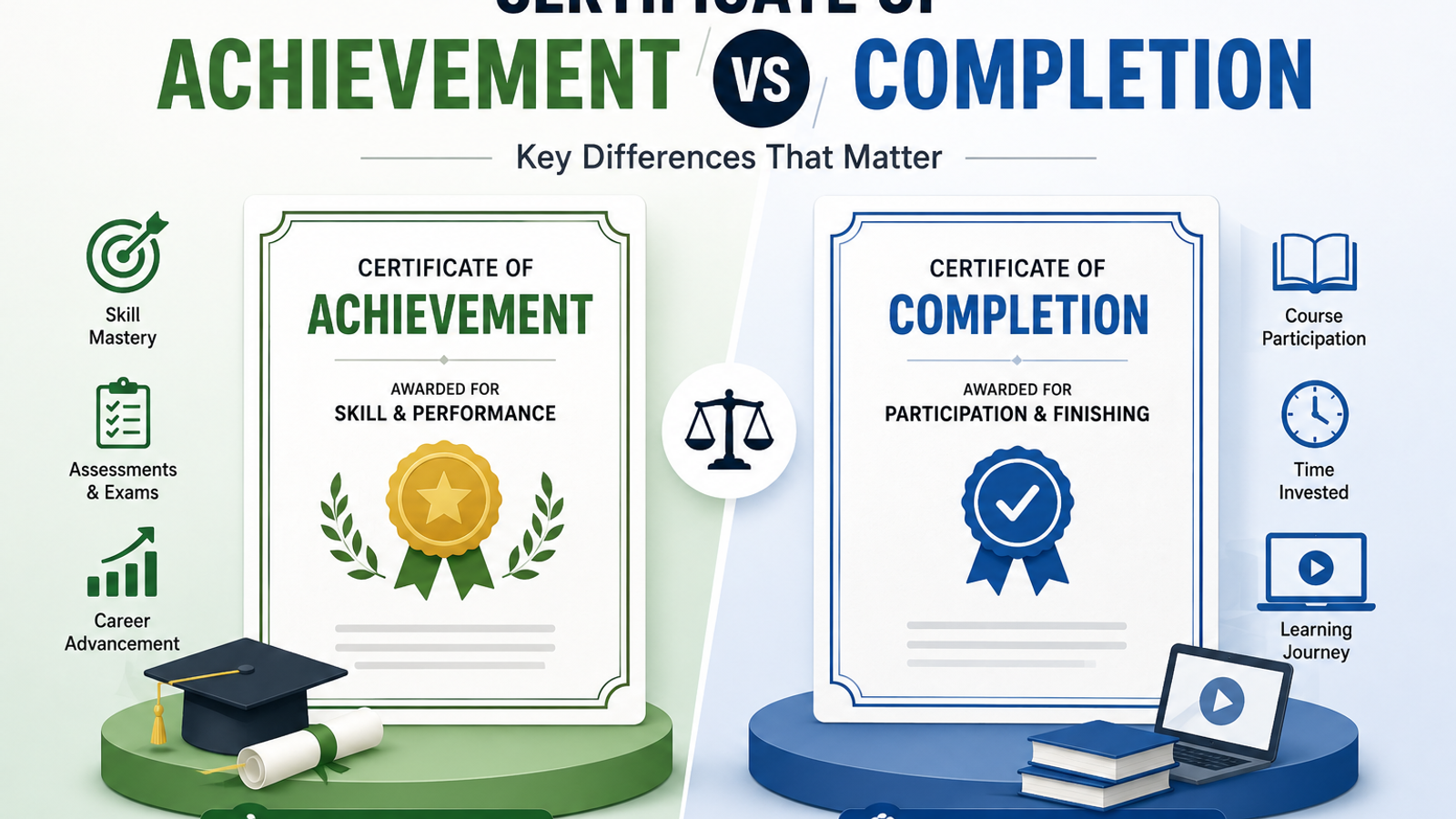
Certificate of Achievement vs Completion: Key Differences
A certificate can open doors, validate skills, and motivate learners. However, not all credentials carry the same weight. When planning an education program or choosing an online course, it helps to know the difference.
A certificate of achievement is not the same as a certificate of completion.
They award a certificate of completion for finishing a course.
A certificate of achievement requires passing assessments or showing a specific skill level. If you are creating your own learning pathways, it helps to read instructional design guides.
This can help you build a strong training program.
It can also help you set up professional credentials. These guides can help you match your credential goals with industry standards. Choosing the right credential helps students, teachers, and institutions accurately reflect effort, professional growth, and specialized competency.
What Is a Certificate of Completion?
A certificate of completion is a document given to participants. It confirms they attended, took part in, or watched educational materials. Historically, and on many popular MOOCs, platforms issue these documents after learners review all videos, exercises, and assignments.
They do not always require a rigorous exam or a proctored test. Many educators look for reliable certificate of completion templates or resources offering a free certificate of completion to quickly award certificate documents after a student has completed a course.
Core Characteristics
- Focus: Participation, video reviews, training modules, and course completion.
- Assessment: Usually does not require a rigorous final exam or graded performance evaluations.
- Target Audience: Ideal for introductory workshops, corporate compliance training, or short personal development webinars.
Example Scenario
A teacher attends a three-hour professional development webinar on classroom management. Upon finishing the session, they receive a certificate of completion to satisfy annual district training logs. According to US Department of Education guidelines on continuing education units, tracking hours through participation documents remains standard practice for non-credit professional learning.
What Is a Certificate of Achievement?
An organization awards a certificate of achievement to individuals who successfully meet specific performance criteria, pass assessments, or demonstrate mastery of a subject. Modern learning platforms often give accredited certificates to meet changing industry needs. Learners must pass hard course or career track certificates before earning formal recognition. The process of successfully completing these evaluations ensures high standards of professionalism certificates and precise measurement of learner growth.
Core Characteristics
- Focus: Skill acquisition, competency-based learning, and performance.
- Assessment: Requires passing quizzes, practical projects, or final examinations.
- Target Audience: Best for skill-based training, technical courses, vocational programs, and academic milestones.
Example Scenario
A student completes an advanced coding bootcamp. To earn their certificate, they must build a working software application.
They must also pass a timed technical assessment. This results in a certificate of achievement. For insights into how modern tech industries evaluate these verified skills, you can explore reports by CompTIA workforce research.
Key Differences: Achievement vs. Completion
To better understand how these two credentials diverge, let us look at three critical dimensions:
1. Evaluation Criteria
- Completion: Tied to time, video reviews, training modules, and basic presence. If you review all course materials available, you earn it.
- Achievement: Tied to results, skill testing, and official evaluations. If you fail the final exam or career track assessment, you will not receive the certificate. This applies even if you opened many modules.
2. Value in the Job Market
- Completion Certificates show initiative, a willingness to learn basic concepts, and continuous learning.
- Achievement Certificates help hiring managers trust that a candidate can do specific tasks.
- They also show verified knowledge in a field. For more tips on optimizing your credentials for recruiters, read our related article. It covers how to write an impactful resume summary.
3. Institutional Standards
Schools, universities, and professional boards often use strict rules for awards to protect their credibility. Online platforms often give completion credentials freely for participation. When organizations focus on certificates awarding, they must weigh the strictness of their testing standards against broader accessibility.
Pros and Cons of Each Credential
Certificate of Completion
Pros:
- Encourages high initial participation rates and low-barrier learning.
- Easy to scale across large audiences or massive open online courses (MOOCs).
- Low friction for casual learners seeking personal enrichment.
Cons:
- Lacks rigorous proof of skill mastery or industry validation.
- Generally holds lower weight on professional resumes when compared to industry certifications.
Certificate of Achievement
Pros:
- Validates actual knowledge and practical skills through accredited evaluations.
- Highly valued by employers, hiring managers, and academic admissions committees.
- Increases learner motivation through tangible milestones and verifiable proof of competence.
Cons:
- Higher dropout or failure rates because of strict exam policies and passing scores.
- More resource-intensive to create, proctor, and grade.
When to Use Which Certificate
Choose a Certificate of Completion when:
- Hosting general interest workshops, orientation programs, or short seminars.
- Providing corporate compliance training where attendance is the legal requirement.
- Encouraging beginners to finish an introductory module without intimidation.
Choose a Certificate of Achievement when:
- Teaching technical, vocational, or specialized professional skills.
- Administering graded tests, portfolios, or practical career track projects.
- Delivering high-stakes professional development credentials and competency-based learning.
Frequently Asked Questions
1. Which certificate is better for a resume?
A certificate of achievement is often better for a resume because it shows you passed a formal evaluation. It also proves you completed tough assessments and learned specific skills.
2. Do employers value certificates of completion?
Yes, employers value certificates of completion for showing continuous learning, personal development, and active engagement, especially in corporate compliance or software training updates.
3. Can you upgrade a certificate of completion to an achievement certificate?
Some modern platforms let learners take an optional final exam or proctored test after a course.
This can upgrade their credential from completion to achievement.
4. Are certificates of achievement legally recognized?
They depend entirely on the accrediting body or institution issuing them. Accredited vocational schools and professional organizations offer widely recognized achievement certificates.
5. Do certificates of completion expire?
Most do not expire, but they can lose relevance fast in fast-moving fields. These include technology, software development, and digital marketing.
6. Do I need prior experience to earn a certificate of achievement?
It depends on the course level. Beginner-friendly achievement certificates require passing basic skills tests, while advanced career track certificates may require prerequisites.
7. Which certificate type is more common in online learning?
Certificates of completion are common in free or casual online courses. Achievement certificates are standard in paid bootcamps and structured career paths.
8. How do I verify a certificate's authenticity?
Many modern institutions provide digital badges, unique credential IDs, or secure verification links directly on the certificate document to formally acknowledge and confirm validity.
Conclusion & Key Takeaways
Choosing between a certificate of achievement and a certificate of completion comes down to your ultimate goal. If you want to track participation, complete compliance training, or introduce a new concept, use a completion certificate. If your goal is to prove strong skills, boost your resume, and show competence, explore our professional certification guides to find the right track.
- Key Takeaway 1: Completion certificates focus on attendance, participation, and reviewing training modules.
- Key Takeaway 2: Achievement certificates require passing rigorous assessments, exams, and proving functional skills.
- Key Takeaway 3: Tailor your choice of credential to your specific learning objectives, audience requirements, and career goals.
Found this useful?
Try our free tools — calculate your GPA, check college GPA requirements, or generate an attendance sheet in seconds.